Online survey has emerged as one of the most effective instruments that businesses employ in knowing the opinion of the consumers.
What appears a mere questionnaire is a component of an elaborate research mechanism aimed to gauge preferences, project purchasing pattern as well as minimize the risks in the business.
Online surveys require online surveys to influence decisions worth millions of dollars in 2025 by e-commerce brands, app developers, financial companies, healthcare providers, and global corporations.
This article describes the step by step process of collecting consumer opinions through online surveys using practical examples and real process using current industry practice.
Each section is described in understandable words to ensure that anybody can comprehend how opinions are converted into data and decisions are converted into data.
Online Surveys are the most important today
Online surveys are popular due to the companies being fast, cheap and scalable. Businesses are able to gather thousands of opinions in a few hours as opposed to interviewing people individually.
Online surveys can assist companies to:
- Know what customers like or do not like.
- Test new features, prices, packaging or products.
- Create a measure of customer satisfaction and brand trust.
- Detect issues in advance before they are expensive.
- Compare views by age, income or by region.
The online survey market is also expanding at a rapid pace due to the need of digital business to be fed with constant feedback. With the intensification of competition, businesses rely on actual consumer review rather than speculations.

How Companies Get the people to take Surveys
Respondent recruitment is the initial stage in gathering the opinions of consumers. The question of a person to answer the survey is equally important to the questions.
1. Website and App Visitors
There are many surveys that are observed when users:
- Complete a purchase
- Cancel a subscription
- Contact customer support
- Leave a website
These surveys take the views of actual users who have just had an experience. Feedback is very relevant but can be biased towards extreme (very happy or very unhappy users).
2. Email Surveys
Firms email surveys to the customers. These surveys are useful for:
- Post-purchase feedback
- Loyalty programs
- Service quality reviews
The response rate in email surveys is usually low, and information is useful as the respondents are confirmed customers.
3. Online Research Panels
Research panels are big companies of individuals who are willing to complete surveys on a regular basis. The members of the panel are of various ages, locations, career and lifestyle.
Panels may be:
- Probability-based and individuals are selected at random.
- Non-probability-based, which is the voluntary joining by people.
- Panels enable the researcher to get the opinion that most accurately represents the population at large.
Designing Survey questions to get the Real Opinions
The survey questions are very well composed in order to minimize confusion and biases. Even with large sample, poorly constructed questions may give misleading results.
Common Question Types
- Multichoice questions to provide fast and clear answers.
- Questions of the rating scale (such as 1-5 levels of satisfaction).
- Strong agree or strongly disagree type of agreement scales.
- Unstructured questions which give individuals the chance to give their views in their language.
Skip Logic and Smart Design
The current surveys employ skip logic that displays only the pertinent questions as per the answer to the previous questions. This makes the surveys less lengthy and dull, thus raising the completion rates.
Mobile-First Surveys
Majority of the surveys are filled on phones. Due to this, surveys have become:
- Shorter
- Easier to read
- Devoid of lengthy grids and ornate design.
- This has dramatically enhanced quality of response.
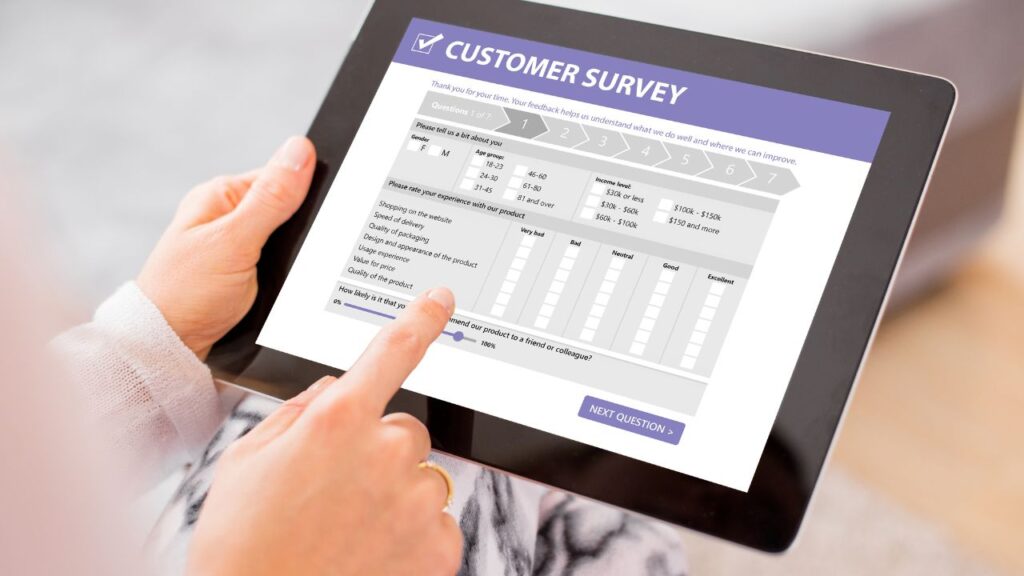
Response Rates and Why They Are Important
Not all the people who will be invited to a survey will answer. Response rate is the percentage, which represents the number of individuals who take part in survey.
Common response rates are determined by:
- Survey length
- Incentives offered
- How the survey is delivered
- Audience interest
The nonresponse bias may arise due to low response rates, in which some groups will be under-represented. In order to minimize this risk, weighting and quality controls are employed by researchers after collection of data.
What Do You Do With a Survey When You Are Finished.
After the gathering of responses, actual work starts. Unprocessed survey data are never processed directly.
Step 1: Data Cleaning
Researchers remove:
- Duplicate responses
- Extremely fast completions
- Random clicking suggestive patterns.
- Automated or bot responses
The step safeguards the data of consumer opinion.
Step 2: Coding Open-Ended Responses.
Open-ended responses are classified into themes like:
- Price concerns
- Product quality issues
- Delivery problems
- Feature requests
This transforms written feedback into data.
Step 3: Weighting the Data
Weighting is used in the calm of some groups being over-represented, in which case the results are adjusted to make the survey more representative of the actual population. This enhances impartiality and consistency.

Precision, Size of Sample, and Margin of Error.
Survey accuracy depends on:
- Sample size
- How people are selected
- Question design
The bigger the sample the more stable the results are expected to be. Most professional surveys comprise of 1000 respondents or more respondents in order to diminish uncertainty.
The margin of error indicates the level of accuracy that the survey will be close to the actual population opinion. The lower the margin, the greater the accuracy.
The online surveys are the most suitable when:
- Respondents are a mirror of the actual population.
- Weighting is correctly done.
- Poor quality of responses are eliminated.
Privacy and Data Protection of Web Survey.
Personal information is usually gathered in online surveys, thus data privacy is very crucial.
Key Privacy Practices
- Express prior to data collection.
- Discussion of the intended use of data.
- Minimized gathering of personal needless information.
- Secure storage of responses.
Global Privacy Standards
Several surveys adhere to the international data protection policies where data has to be transparent and controlled by the user. Typically, the right of respondents includes:
- Know what data is collected
- Refuse participation
- Request data deletion
The consideration of the privacy will instill trust and enhance participation.
The way Online Surveys Change Opinions into Insights
| Stage | What Happens | Why It Matters |
|---|---|---|
| Recruitment | Respondents invited by websites, email, or panel | determines the aspect of representativeness |
| Question Design | Simple, mobile-friendly questions | Improves accuracy and completion |
| Data Collection | Responses collected across devices | Requires quality checks |
| Reporting | Insights published in charts and dashboards | Enables action |
| Privately Controls | consent and data protection used | Maintains trust and compliance |
The process involved in obtaining consumer opinions using online surveys is quite complex because it involves a well-organized, multi-step procedure that extends way beyond the simple questions.
Whether it is the way to recruit the appropriate respondents or how to create a mobile-friendly survey, data cleansing, weighting, or ensuring privacy, all the steps count.
Online surveys will continue to be one of the most effective instruments in knowing what customers want, how to make the product better, and make the right decision in 2025.
They can turn ordinary opinions into potent ideas that drive markets, services and consumer experiences when done in the right way.