
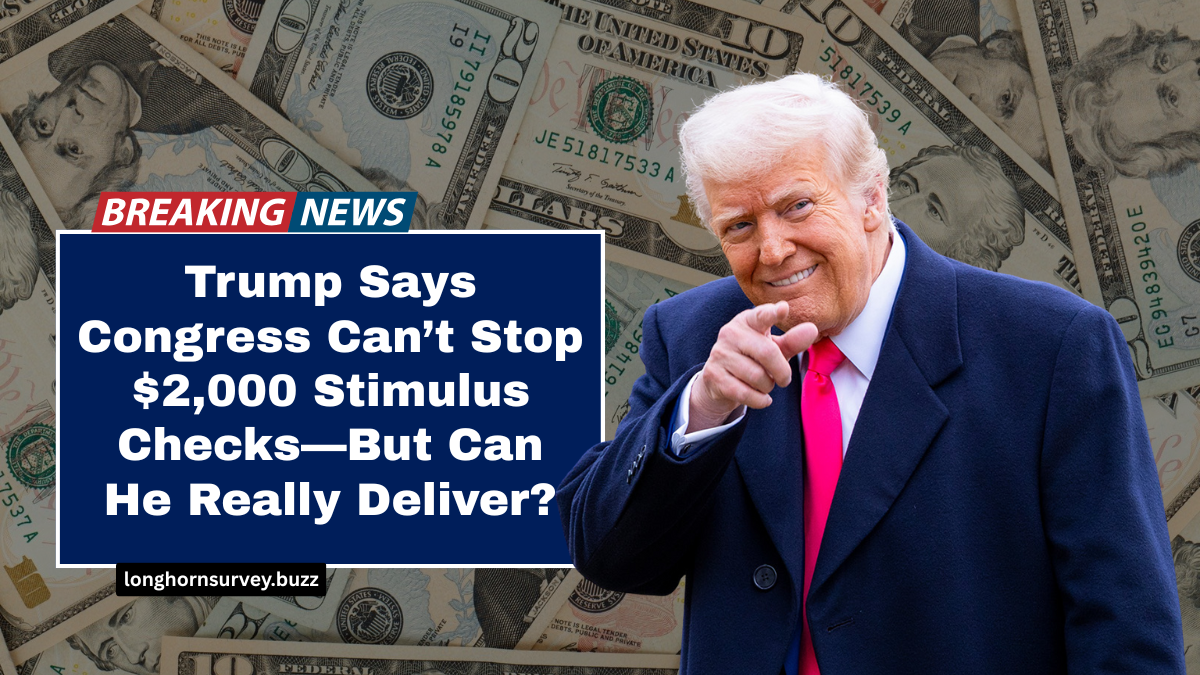
The idea of $2,000 stimulus checks coming back has once again grabbed national attention. This time, former U.S. President Donald Trump is making a bold claim. He says Congress cannot stop him from sending these payments to Americans. That statement has surprised many people, including lawmakers, economists, and legal experts.
While millions of families are hoping for financial relief, the big question remains: Can Trump really deliver $2,000 stimulus checks without Congress? The answer is not simple. This issue involves laws, money, and political power, all mixed together. Let us break it down in a clear and easy way.
Also Read
The $2,000 Stimulus Check Promise Explained
Trump has repeated his promise to send $2,000 stimulus checks to low- and middle-income Americans. In a recent interview, he said lawmakers would not be able to block it.
This claim goes against what most legal experts believe. In the United States, Congress controls government spending, not the president alone. Even Trump’s own economic advisers have said that lawmakers must approve any large payment plan.
The Idea Behind the “Tariff Dividend”
What Is the Tariff Dividend?
The plan started in mid-2025 and was first called the “tariff dividend.” Trump explained that money collected from tariffs on foreign goods could be returned to citizens as stimulus checks.
Later, he clearly stated the amount on social media: $2,000 per person for qualifying families. Politically, this sounds attractive, especially during election season. But financially and legally, it is far more complicated.
Why Congress Is a Major Roadblock
Who Controls Federal Spending?
Under the U.S. Constitution, only Congress can approve federal spending. This includes stimulus checks.
Even Trump’s Council of Economic Advisers admitted that Congress must define and approve how the money would be distributed. Senate leaders have already called the idea unrealistic and warned of a serious constitutional fight if checks are issued without approval.
The Biggest Problem: Where Will the Money Come From?
Trump has claimed that tariffs have raised nearly $600 billion. However, official data tells a different story.
Real Numbers vs Claims
According to government estimates, tariff revenue for 2025 is closer to $289 billion. That amount is far lower than what is needed.
Here is a simple comparison:
| Item | Estimated Amount |
|---|---|
| Tariff Revenue (2025) | $289 billion |
| Cost of $2,000 Checks | $450–$660 billion |
| Funding Gap | Hundreds of billions |
Even if all tariff money was used, it would not be enough to pay for the checks.
Legal Risks Could End the Plan Completely
Another serious issue is a Supreme Court case currently reviewing the legality of the existing tariff system.
If the court rules against it, future tariff revenue could stop. Even worse, the government might have to refund money already collected. That would completely collapse the idea of using tariffs to fund stimulus payments.
A Smaller Example That Already Exists
The “Warrior Dividend”
While the $2,000 checks remain uncertain, a smaller program has already been approved. Known as the “Warrior Dividend,” this plan provides a one-time $1,776 payment to active and retired service members.
The key difference? Congress approved it.
This proves that stimulus-style payments are possible—but only when lawmakers agree and funds are clearly allocated.
What This Means for Americans in 2026
Right now, the promise of $2,000 stimulus checks is more of a political statement than a guaranteed plan. Between constitutional limits, funding shortages, and legal risks, many hurdles remain.
Families should stay informed but cautious. Until Congress passes a law and funding is secured, these checks are not guaranteed.
The idea of $2,000 stimulus checks is exciting for many Americans who are struggling with rising costs. However, promises alone do not create payments. The U.S. system requires Congressional approval, clear funding, and legal backing.
Trump’s claim that Congress cannot stop the checks faces strong opposition from facts, law, and financial reality. While smaller stimulus programs show that payments are possible, the larger plan remains uncertain. For now, Americans should watch developments closely and rely only on officially approved policies, not campaign promises.
FAQs
Are $2,000 stimulus checks approved for 2026?
No. As of now, there is no approved law guaranteeing $2,000 stimulus checks.
Can the president send stimulus checks without Congress?
No. Federal law requires Congress to approve spending for stimulus payments.
Is tariff money enough to fund the checks?
No. Current tariff revenue is far less than what is needed to cover the full cost.